Your Guide to Spider Control & Prevention Services
Green Pest Services | Port St Lucie | Palm City | Stuart | Tradition
Common Spiders in Florida: What You Need to Know
Living in Florida means sharing your property with all kinds of different spiders. That’s just Florida. Most of them are completely harmless. Some are even beneficial. A small few, however are venomous and potentially medically significant.
Identifying what you’re dealing with can help you decide if you need a pest control service or just a broom.
We’ve photographed and identified 8 of most common spiders and/or dangerous spiders our technicians encounter in Port St Lucie & Palm City. Here’s what you’re actually seeing when you spot a large and eight-legged arachnid on your wall at night.
Quick Reference: Common Spiders of Port St Lucie & Palm City, Florida
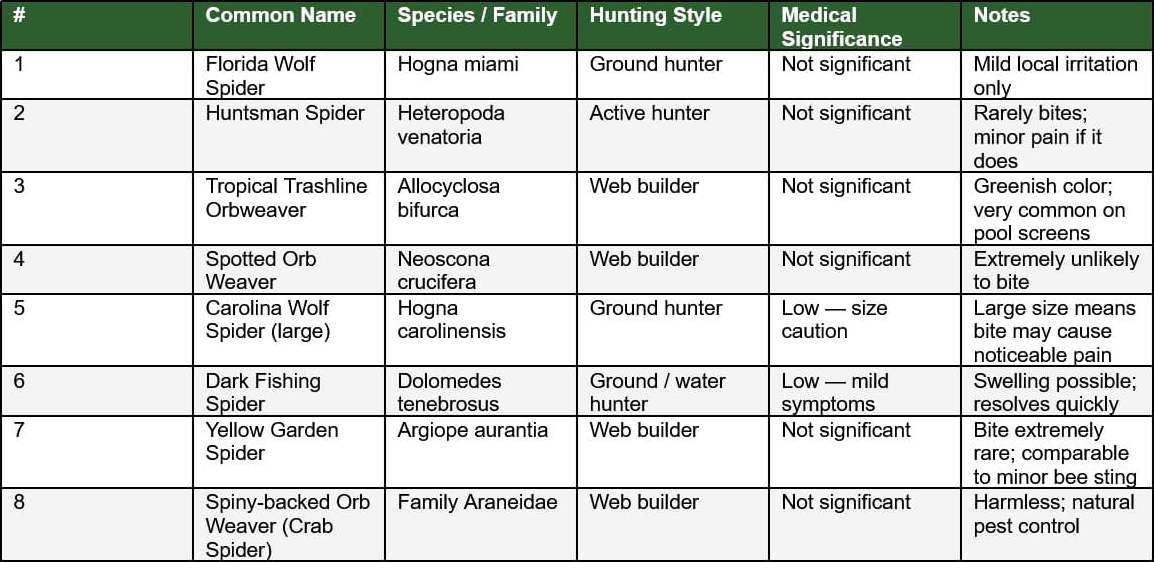
(Click to enlarge)
Important: None of the spiders in this table are medically dangerous. Florida’s few genuinely dangerous spiders (Black Widow/Brown Widow & Brown Recluse) are covered toward the bottom of this page.
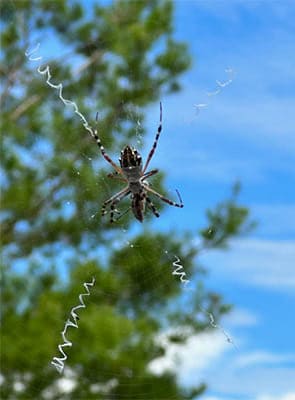
Silver Argiope (Argiope argentata) can be extremely intimidating but are largely harmless.
Spider Identification Guide: Tradition, Port St Lucie & Palm City
Below are the eight spiders we see most often on service calls. None of them are medically significant. That doesn’t mean you want them running around your home or business, but it does mean there’s no need to panic.
All photos below were taken locally in St. Lucie or Martin County but most of these spiders can be found throughout the state of Florida.
1. Wolf Spider (Hogna miami) (Lycosidae)
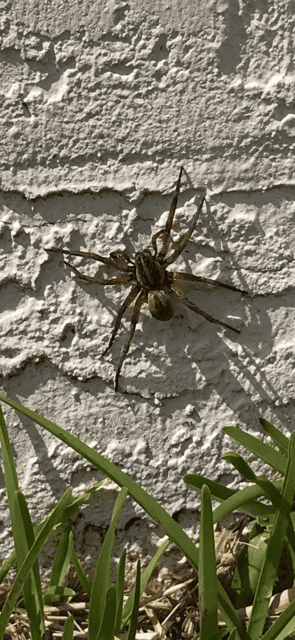
What it looks like: Large, brown or gray with a stripe down the back. Robust build, long, powerful legs. They don’t create webs but instead hunt on the ground as ambush predators. Perhaps the most horrifying story you have ever heard: Females often carry hundreds of their young on their backs. We have spoken to many people who stomped on one to kill it, only to have hundreds of baby spiders scatter all over the floor. Not fun.
Where you find it: Lawns, gardens, under rocks, along exterior walls. Ground level. Nocturnal. They wander into garages and under doors, especially in the rainy season.
Hunting style: Active ground hunter. Chases down prey – does not create a web.
Will it bite? Only if you grab it or corner it. The bite feels like a bee sting: temporary pain, mild redness, nothing serious.
Pest control: Exclusion is always helpful. Another important step to making sure you don’t see the large spiders in your home is turning off exterior lights. The flying insects drawn to porch lights create an all-you-can-eat buffet situation for these spiders. From there, they can easily enter the home from underneath a sliding glass door.
2. Huntsman Spider (Heteropoda venatoria)
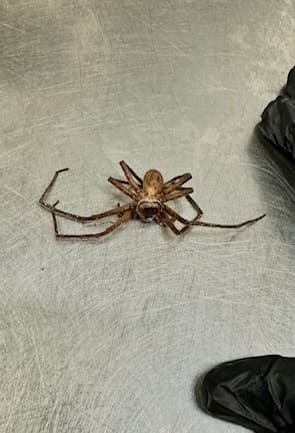
Huntsman Spider (Heteropoda venatoria)
What it looks like: Very large – exceptionally long legs, up to 4 inches. Crab-like posture with legs splayed outward. Flat body, tan or brown. Often mistaken for a tarantula, though not as robustly built.
Where you find it: Indoors and out. Garages, warehouses, storage rooms. Fast-moving when startled. This is an introduced species that came to Florida in shipping containers and never left.
Hunting style: Active hunter. Does not build webs. One of the fastest spiders you’ll encounter.
Will it bite? Rarely. Bite is mild and brief. They’d much rather run than fight.
Pest control: We get calls about these often. The size understandably triggers panic. Like the Wolf Spider, sealing entry points and reducing conducive conditions, such as exterior lighting, can make a big difference.
3. Tropical Trashline Orbweaver (Allocyclosa bifurca)
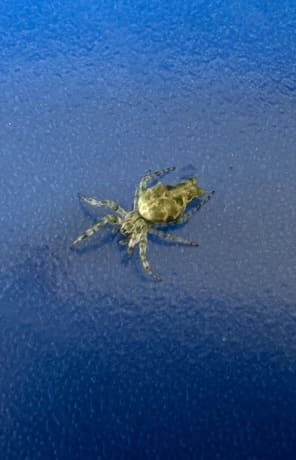
Tropical Trashline Orbweaver (Allocyclosa bifurca)
What it looks like: Small to medium-sized orb weaver with a muted olive green to yellowish green coloration. The abdomen has a distinctive, bumpy, tuberculate surface—not smooth. Stocky legs with alternating light and dark banding. The overall coloration provides excellent camouflage against vegetation and screens.
Where you find it: Extremely common on pool screens. One of the most common complaints we hear from pool owners in Port St. Lucie is also found on exterior walls, under eaves, and on vegetation that is near exterior lighting. These spiders build small orb-type webs, typically with a distinctive vertical “trashline” running through the center.
Hunting style: Classic orb weaver with a signature twist—it constructs a vertical line of wrapped prey debris, egg sacs, and plant material (the “trashline”) down the center of its web. The spider sits camouflaged within this debris line, making it nearly invisible to both prey and predators.
Will it bite? No. Completely harmless. You’d have to physically compress it against your skin, and even then, the bite would be insignificant. (THANKFULLY FOR OUR TECHNICIANS WHO SWEEP THEM DOWN FOR CLIENTS)
Pest control: This is one of the most common pool screen spiders we encounter on service calls in Port St. Lucie and Martin County. Clients often mistake the greenish coloration for something exotic or dangerous—it’s neither. The trashline debris can make the web more visible and less aesthetically acceptable than other orb weaver webs, which is usually why people call. To obtain control, we treat the brush heads of our sweepers with an insecticidal dust. Most homeowners who call about this issue have already swept them down themselves, but inevitably, within days, the spiders seem to be back again. This is because simply sweeping them down does nothing to prevent them from crawling back up again.
Color identification tip: *Allocyclosa bifurca* is greenish/olive. If you see a similar-looking Trashline Orbweaver with brown or reddish coloration, that’s likely *Cyclosa bifurcata* (a close relative). Both are harmless and common on pool screens.
4. Spotted Orb Weaver (Neoscona crucifera)
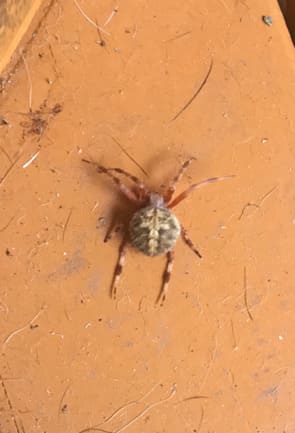
Spotted Orb Weaver (Neoscona crucifera)
What it looks like: Bulbous abdomen with mottled gray, brown, and white patterns. Builds large circular webs, often between structures or across outdoor lights.
Where you find it: Exterior webs between fences, trees, buildings, and porch lights. The spider sits in the center of the web at night. During the day, it hides nearby.
Hunting style: Classic web builder. Rebuilds the web nightly.
Will it bite? Extremely unlikely. You’d have to physically press it against your skin. Even then, the bite is harmless.
Pest control: Sweep it down with a broom, and leave porch lights off to avoid drawing their prey to your home.
5. Large Wolf Spider / Carolina Wolf Spider (Hogna carolinensis)
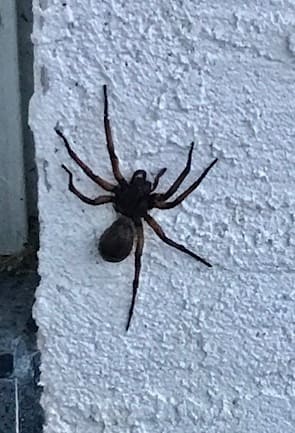
Carolina Wolf Spider (Hogna carolinensis)
What it looks like: One of the largest wolf spiders in North America. Brown with distinct stripe markings. Powerful, spiny legs. Impressive (frightening?) size.
Where you find it: Exterior walls, especially at night, around porch lights where insects gather. Near ground level, generally.
Hunting style: Same as smaller wolf spiders – they hunt on the ground and do not build webs.
Will it bite? Similar to most spiders: only if handled or cornered. The larger size means a bite might hurt more, but it’s still not medically significant. Localized pain, mild swelling, generally not serious.
Pest control: Their sheer size makes them rather terrifying for most people. This is one of the most common “emergency” spider calls we get. It looks scary, but it’s not dangerous. Our service, along with leaving exterior lights off at night, will get these spiders off your property quickly.
6. Pantropical Jumping Spider (Plexippus paykulli)
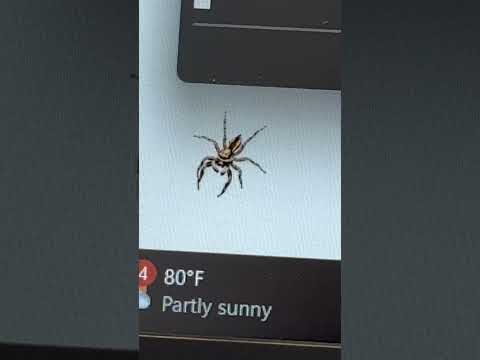
What it looks like: About the size of a nickel. Grey and black with a distinctive white stripe down the middle of its body.
Where you find it: Very common around and even inside buildings. Typical among jumping spiders, and in stark contrast to most other families of spider, it has an interesting and engaging personality. You might even say they’re cute!
Hunting style: Ground hunter. As the name suggests they are ambush predators and do not build webs.
Will it bite? Extremely rare and not medically significant.
Pest control: Regular pest control will eliminate these spiders, but honestly, an occasional one in the office or warehouse isn’t hurting anything.
7. Yellow Garden Spider / Writing Spider / Zipper Spider / Banana Spider (Argiope aurantia) + Silver Garden Spider (Argiope Argentata)
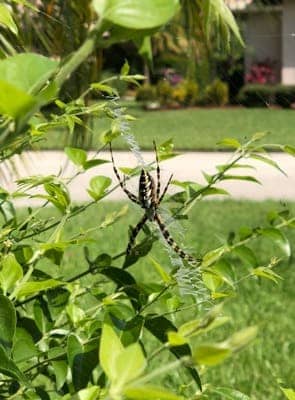
Yellow Garden Spider (Argiope aurantia)
What it looks like: Impossible to miss. Large female with silvery head/thorax and bold black-and-yellow striped abdomen. Black legs with yellow and red banding. The signature feature: a thick white zigzag silk pattern woven into the center of the web (called a stabilimentum) resembling a zipper. The spider rests head-down in the web. The closely related Silver Garden Spiders makes a similar shape in its web but patterned in the shape of an X instead of a single vertical pattern.
Where you find it: Open, sunny areas. Gardens, shrubs, fence lines, between structures. The zigzag web is unmistakable.
Hunting style: Classic orb weaver. Builds large circular webs to catch flying insects.
Will it bite? No. Not unless you physically trap it and compress it against your skin, which few people are brave enough to do. Even if it did bite, it’s comparable to a minor bee sting.
Pest control: Easily controlled but very beneficial for controlling many flying insects.
8. Spiny-backed Orb Weaver Spider (Family Araneidae)
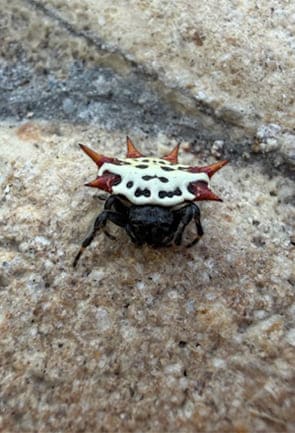
Spiny Orb Weaver (Gasteracantha cancriformis) anterior view
What it looks like: While the family Araneidae has many species, the most common in our area resembles a crab. A bulbous white abdomen, with black spots, black legs, and bright red spikes. Truly exotic in appearance. Builds classic circular webs.
Where you find it: Anywhere with structures to anchor a web, but it especially loves a good pool screen to call home.
Hunting style: Web builder. Waits in the web for prey to fly into it.
Will it bite? Almost never. Completely harmless.
Pest control: Easily controlled with a regular pest control service.
The Only Two Florida Spiders Worth Worrying About

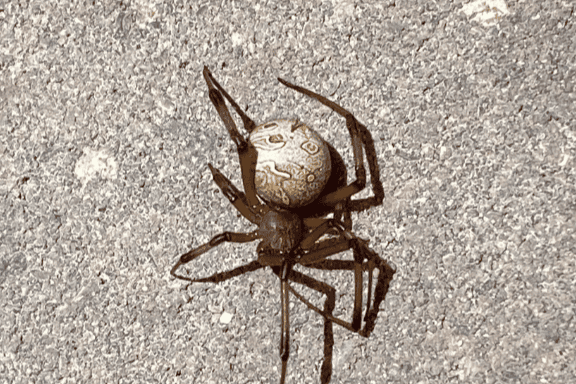
Black Widow – Shiny black, red hourglass marking on underside, builds messy webs usually in dark corners (garages, crawl spaces, AC units). The closely related Brown Widow looks very similar but as you might have guessed is more brown than black. Interestingly, Florida is also home to the endemic Red Widow Spider, though this species is rare and only found in scrub habitat.

Brown Widow – also features black bands or stripes on its legs around the joints. In recent years, the Brown Widow has become the more common species in our area. They absolutely love new construction. This makes them a particularly acute problem in Tradition. Our own office – a new commercial construction in Tradition – had these spiders when we first moved in. Almost to a tee, they show up in unfinished buildings and don’t decide to move out just because people show up later when the construction is done.
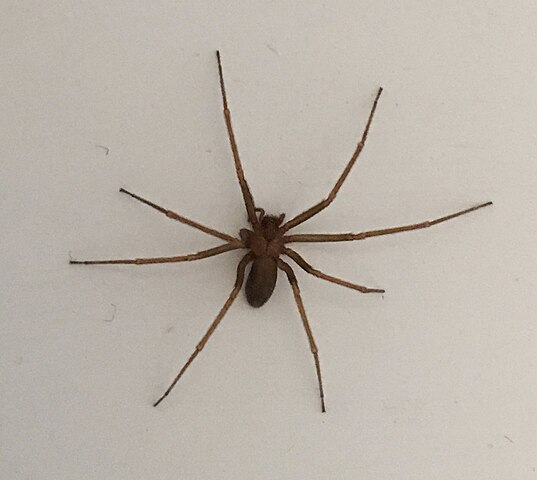
Brown Recluse
All of the images on this page are original images and videos taken by us in the field here in Florida – except this one. That is because Brown Recluse spiders are so rare in South Florida that despite thousands of services performed we have never obtained an original image or video of one.
Brown Recluse – Extremely rare in South Florida. Tan/brown, violin-shaped marking on back. Reclusive (the name is accurate). We have never seen a confirmed recluse bite in our area. Brown Recluse spiders are not native to Florida, and according to the University of Florida, there is no evidence of a sustained population of these spiders in the state. Most confirmed incidences of Brown Recluse spider bites are associated with items such as boxes or moving trucks being brought in from areas where these spiders are native (states along the Mississippi River and Texas). Most “recluse bites” turn out to be staph infections or other medical issues, not spider bites at all.
When to Call Pest Control for Spiders
- You need professional spider control if:
- You’ve confirmed Black Widows in or around your building
- You’re seeing spiders inside regularly (indicates entry points and/or an insect problem attracting them)
- You have heavy webbing around eaves, soffits, or entry points (common in Florida on commercial buildings and homes near retention ponds)
- You run a commercial property where customer perception matters (restaurants, medical offices, retail—even harmless spiders scare clients)
- You have tenants complaining about spiders (similar to other businesses, more of a perception issue, not necessarily a safety issue)
You probably don’t need pest control if:
- You saw one large spider outside
- You found a harmless orb weaver web in your garden
We’ll be honest with you either way.
Spider Control Services - What We Do
Exterior Barrier Treatment – Liquid treatment around the foundation, eaves, soffits, door frames, and window frames. Reduces spider activity and eliminates the insects they’re feeding on.
Web Removal – Physical removal of active webs and egg sacs. Particularly important for commercial properties where appearance matters.
Exclusion Recommendations – We’ll identify entry points (gaps under doors, cracks in foundation, unsealed utility penetrations) and recommend fixes. Exclusion is important for a whole host of issues.
Interior Spot Treatment – If you have spiders inside, we treat harborage areas (corners, closets, storage rooms, garages). We also address the insect populations that attracted them in the first place.
Ongoing Maintenance Plans – Regular treatments keep spider populations low and prevent webbing buildup. Especially valuable for commercial clients in high-visibility locations. And prevention of Plaster Bagworms.
FAQs - Spider Control in Stuart & Treasure Coast FL
Are wolf spiders dangerous?
No. Wolf spiders are not medically significant. Bites are rare when they do happen a bite causes temporary localized pain similar to a bee sting.
I found a huge spider in my garage. Is it a tarantula?
What's the spider with the zigzag web?
Do Brown Recluses live in Florida?
How do I keep spiders out of my house?
Are spiders covered under a regular pest control plan?
I have Black Widows around my patio and inside my garage. What should I do?
Will killing spiders make my bug problem worse?
What's the best time of year for spider control in Florida?
Service Areas - Spider Control
Green Pest Services provides spider control and identification services throughout Martin County and St. Lucie County:
Primary Service Areas:
- – Port St Lucie (34987) – We service all of Port St Lucie but here are a list of neighborhoods within the same zip code as our office, and all of these neighborhoods are withing 5 miles of our home base: Bedford Park, Belterra, Cadence at Tradition, Copper Creek, Del Webb at Tradition (55+), Eden at Tradition, Emery, Encore at Tradition, Esplanade at Tradition, Heritage Oaks, Heron Preserve, Kenley at Tradition, Lake Park at Tradition (55+), Manderlie at Tradition, Marrita Reserve, Mosaic, Preserve at Tradition, Promenade at Tradition, Seville, Tavalo at Tradition, Telaro at Tradition, The Atlantic, The Boardwalk, The Brennity, The Estates at Tradition, The Lakes at Tradition, Town Park at Tradition, Victoria Parc at Tradition, Vitalia at Tradition, Westcliffe Estates, Riverland, Valencia Cay at Riverland, Valencia Grove at Riverland, Valencia Walk at Riverland, Valencia Parc at Riverland, Valencia Vista at Riverland, Valencia Riverwalk, PGA Village, PGA Verano, The Legacy at PGA Village, The Reserve at PGA Village, Island at PGA Village, Cypress Lakes at PGA Village, Astor Creek Golf & Country Club, Veranda Plantation, Magnolia Lakes.
As you can see, if you live in Tradition, we are your neighbors, right near you!
- Palm City (34990) – Martin Downs, Harbour Ridge
- Martin County – Stuart, Jensen Beach, Hobe Sound
If you’re in the Treasure Coast area and dealing with spiders (or think you are), give us a call. We’ll identify what you’re seeing, explain whether it’s a problem, and recommend treatment only if it actually makes sense.
Why Green Pest Services?
- Local experts – We live here. We know the spiders you’re dealing with because we see them every day.
- Honest recommendations – If you don’t need treatment, we’ll tell you. If you do, we’ll explain why.
- Accurate identification – We won’t misidentify a harmless spider as dangerous just to sell a service.
- Licensed & insured – Professional pest control operators.
- Always next-day service – Because we understand the sense of urgency with spider problems.
Green Pest Services
📍 11958 SW Tom Mackie Blvd, Unit 104, Port St Lucie FL 34987
📍 1111 SW Martin Downs Blvd, Palm City FL 34990
📞 772-528-5839
*All spider photos on this page were photographed locally in Martin County, FL by Green Pest Services. Species identifications verified by professional entomological AI analysis (Claude, Anthropic). For accurate spider identification in your home or business, contact us at 772-528-5839.*
We treat every Port St. Lucie home like our own — honest service, pet-safe methods, and next-day appointments when you need us. Our clients consistently leave great reviews on our service.
-Shane Green. CEO, Green Pest Services FL