
Centipedes and Millipedes in Florida
Quick Answer: Are Centipedes and Millipedes in Florida Dangerous?
Centipedes and millipedes are among the most common — and least dangerous — pests in Florida homes. Centipedes, including the fast-moving house centipede (Scutigera coleoptrata) and larger native species, can deliver a mildly venomous bite if handled, but it is not dangerous to a healthy adult and feels roughly like a bee sting. Millipedes cannot bite or sting at all — instead they release a defensive secretion (mostly benzoquinones) that can cause a temporary skin irritation known as “millipede burn.” Neither animal infests a home the way ants or roaches do. Both are moisture-driven and most active during the Treasure Coast rainy season, roughly May through October, when heavy rain floods them out of the soil and they wander up exterior walls and into garages. Green Pest Services treats centipede and millipede problems for homes and businesses in Port St. Lucie, Tradition (34987), Palm City (34990), Stuart, and across the Treasure Coast.
Red Rusty Millipedes Around Tradition Homes
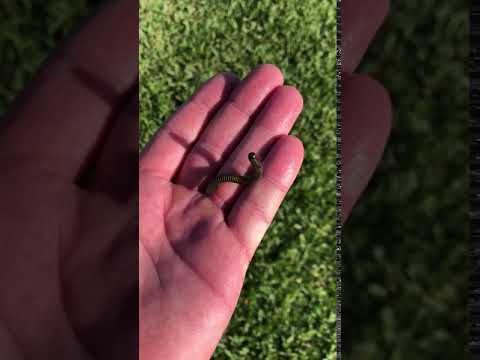
This is a red rusty millipede (Trigoniulus corallinus), filmed in a Tradition yard right here in Port St. Lucie — one of the three millipede species you’re most likely to find around a 34987 home, and the one that turns up most often on driveways, garage floors, and exterior walls after a summer downpour.
Rusty millipedes are harmless. They don’t bite, they don’t damage the house, and they feed on decaying leaves and mulch rather than anything living. When heavy rain saturates the soil, they simply climb to higher ground — which is why you’ll spot them on the walls, not because anything is wrong inside.
Watch how slowly and deliberately it moves. That unhurried, wave-like crawl is the easiest way to tell a millipede from a fast-darting centipede.
There are 3 species of Millipede common throughout Florida and particularly Florida’s southeast coast.
- Yellow Banded Millipede (Anadenobolus monilicornis)
- Red Rusty Millipede (Trigoniulus corallinus)
- Greenhouse Millipede (Oxidus gracilis)
Common Centipedes in Florida
- Florida Blue Centipede (Hemiscolopendra marginata)
Yellow Banded Millipede
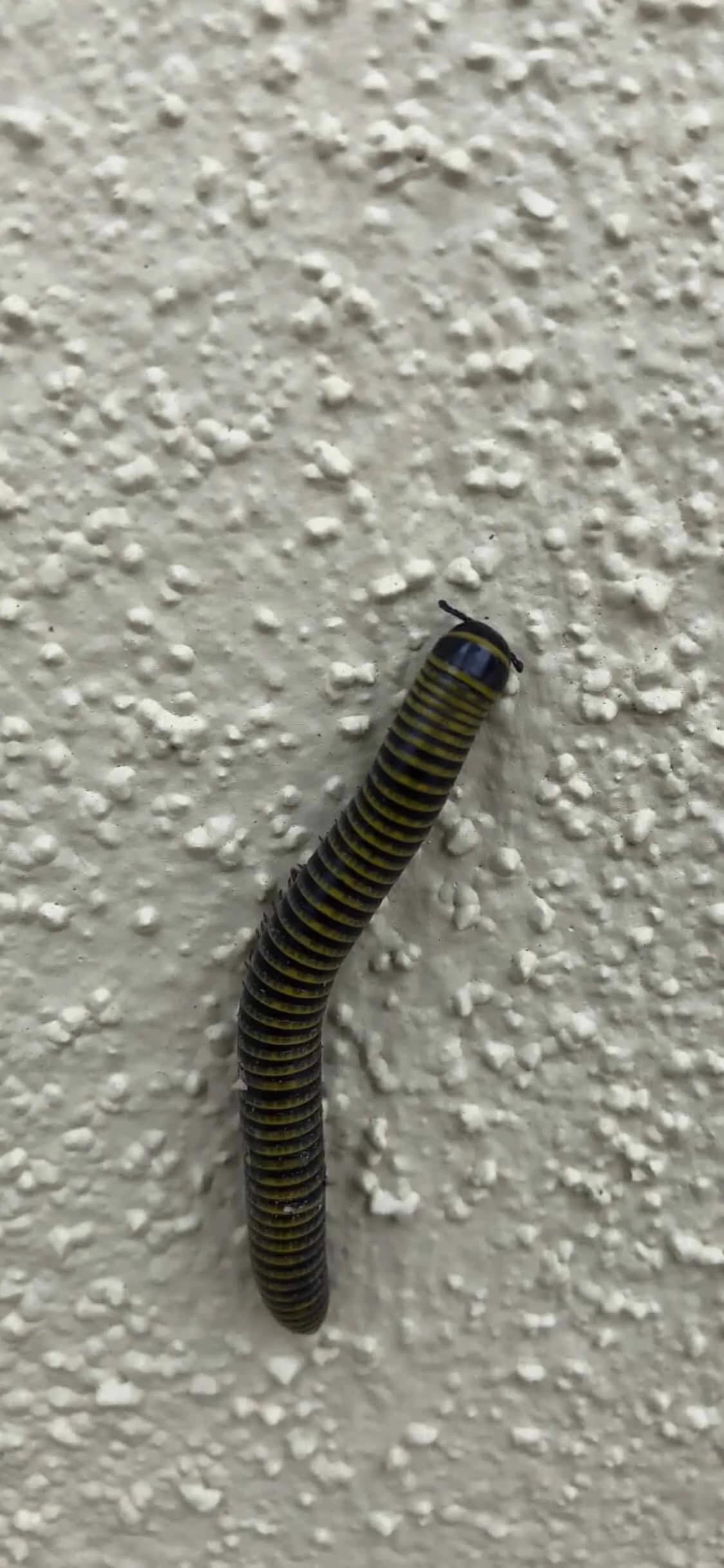
Early in their life cycle, Yellow Banded Millipedes have brighter, more defined yellow bands. As they age, the yellow tends to become more greyish and harder to distinguish from their primary color.
Yellow Banded Millipede – The most common of these pests in Florida is the Yellow Banded Millipede. These are often found curled up dead in homes and crawling up the outside walls of structures.
Though moderately difficult to control, a regular pest control service should reduce or exterminate the millipede population around a home or building. A one-off service is unlikely to produce satisfactory results for more than 1-2 months
Rusty Millipede
The Rusty Millipede is also common in Florida, though much less of a problem in-doors than its yellow-banded cousin. Like all millipedes, it feeds on decaying plant matter and prefers moist shady habitats. Native to southeast Asia, their status as a pest in Florida may grow as they become better established.

Greenhouse Millipede
The Greenhouse Millipede is very common in Florida. Nearly anyone who maintains a garden or has so much as planted a tree in the Southeast United States has likely encountered these small (less than an inch long) millipedes. Only about an inch long, they are essentially harmless, and may actually be beneficial in helping to aerate the soil and breakdown wastes, returning nutrients to the soil.

Florida Blue Centipede
The Florida Blue centipede can range from greyish blue to orange in color
The Florida Blue Centipede is one of Florida’s most recognizable native centipedes. Unlike millipedes, centipedes are aggressive carnivores that eat insects, worms, snails, – essentially any other creature small enough for them to overpower and consume. They are nocturnal and prefer dark, moist areas.
What Is the Fast Centipede I See Indoors? (The House Centipede)
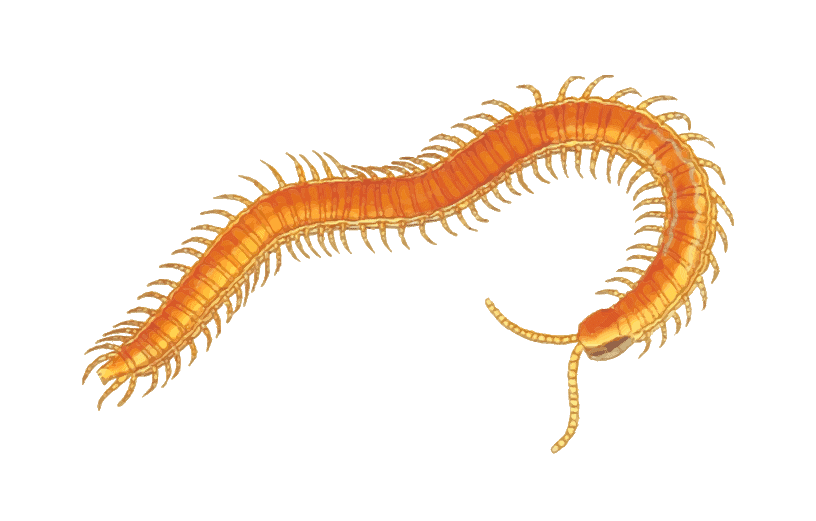
The house centipede (Scutigera coleoptrata) is the centipede most Florida homeowners actually encounter indoors — and the one behind the classic 2 a.m. bathroom startle. It has 15 pairs of long, banded legs and moves with unsettling speed across floors, walls, and ceilings. Its body is only about an inch to an inch and a half long, though the sweep of its legs and antennae can make it look three to four inches across.
Unlike Florida’s larger outdoor centipedes, the house centipede is the one species that can live and reproduce entirely indoors. It favors humid rooms — bathrooms, laundry rooms, garages, and the spaces under sinks. It is not, however, a threat to your home or your family. It builds no nest or colony, it does not damage the structure, and it has a long life span of three to seven years.
Here is the part most people don’t expect: the house centipede is a beneficial predator. It hunts cockroaches, silverfish, ants, small spiders, and other household arthropods, usually at night. Seeing one is often a sign that there are other insects in the home for it to eat — which is why the lasting fix is addressing that underlying pest activity rather than chasing the centipede itself.
Can it bite? Technically yes — house centipedes are venomous, like all centipedes — but a bite requires handling or trapping one against your skin, and even then the result is mild, comparable to a bee sting. For nearly everyone, the house centipede is harmless. If their appearance bothers you, the most effective approach is reducing indoor humidity and treating the pests they’re feeding on. For help identifying or controlling the insects behind a centipede problem, see our ant control and Port St. Lucie pest control pages.
Are Millipedes Poisonous?
I’ve heard of something called Millipede Burn
Most Millipedes in Florida are generally not dangerous. Their primary mechanism of defense is to curl up into a tight ball, protecting their legs and softer underbelly. They do however have the ability to produce mild toxins meant to deter predators. Your dog would be unlikely to consume a millipede due to its foul taste, but in the event, serious medical consequences appear to be rare. You may, however, want to seek the advice of a veterinarian if you believe your pet has consumed a millipede.
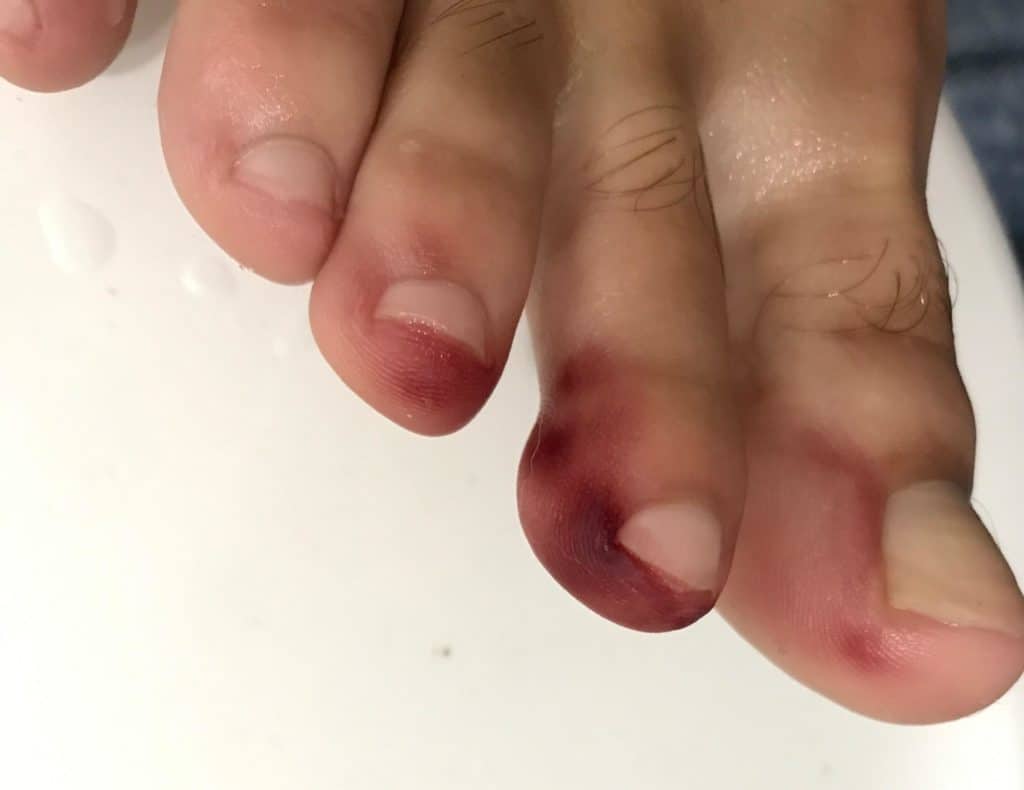
If a crushed millipede should come in contact with your skin – such as stepping on one barefoot – you may become affected by something called “Millipede Burn”. This is essentially a chemical burn caused by toxins released from the crushed millipede. The severity of this condition will depend on the species of millipede and the duration of contact.
Yellow Banded Millipedes most common in South Florida have the ability to cause this skin condition, though it is relatively mild compared to species found in other parts of the world.
Children are most likely to be affected by this condition because of time spent outside and often barefoot. Children may also be particularly vulnerable because of more sensitive skin and because children may be more likely to ignore the substance at first instead of immediately washing the affected area.
The acidic chemicals contained within the millipede may also stain the skin or induce reactions that cause discoloration. Nevertheless, with the species common in Florida this is a relatively mild condition that typically passes quickly. As with anything else, allergic reactions are always possible.
Do Millipedes & Centipedes Bite?
None of the Millipedes commonly found in Florida bite. The Florida Blue Centipede can and will bite, though generally only when threatened or being handled.
Do Millipedes & Centipedes live in the House?
Centipedes and Millipedes generally do not live inside homes because their food sources are outside and they require high levels of moisture to survive. That said, because they live on or below ground, heavy rains can flood them out of their living space and cause them to enter homes seeking higher ground.
Are Centipedes Poisonous?
Unlike millipedes, centipedes do have a venomous bite. Though not generally considered a serious threat to human health, a centipede’s poisonous bite is painful. Children, the elderly, or anyone experiencing an allergic reaction should consult a physician if they have experienced a centipede bite.
Are Millipedes & Centipedes dangerous to Dogs & Cats?
Centipedes and Millipedes present essentially the same, very mild, a threat to the health of pets that they do to humans. There is, however, the increased chance that a dog or cat may eat one of these arthropods. These animals natural defense mechanisms stand a good chance of deterring pets from eating them. If your pet does consume a millipede or centipede, watch for signs of distress in your pet and contact a veterinarian.
Tips on how to get rid of Millipedes & Centipedes in Florida.
Millipedes survive and thrive by feeding on decaying plant matter. Centipedes hunting in similarly moist areas. Opting for lava rock or rubber mulch as opposed to wood can make some difference in their population around a home. Removing dead leaves and branches the accumulate underneath ornamental plants can also help, while keeping hedges and trees well-trimmed allow sunlight to reach the soil will also make conditions less favorable.
Part and parcel to the decaying plant matter millipedes need to survive is high levels of moisture. Dry plant material does not make for a good resource for these bugs. While we cannot control the weather, homeowners certainly can control their sprinkler systems. A common mistake is allowing sprinklers to run on the same schedule throughout the year. Spring in Florida can be both dry and hot requiring a fair amount of water to keep lawns healthy. The summer months are when we receive the majority of our annual rainfall during which time irrigation should be scaled back. Too much moisture will exacerbate already favorable conditions for the pest. Even further, flooding of mulch beds can flush out bugs living there, forcing millipedes and centipedes into homes.
Millipedes have become an increasingly common problem in Port St Lucie, Palm City and the Treasure Coast. The varieties most often found in St Lucie and Martin Counties tend to vary in color from black and brown to red. Though they can secrete a foul odor as a defense mechanism and can stain clothing if crushed, these worm-like insects are relatively harmless. Homeowners will often find them curled up dead inside homes or on the garage floor during South Florida’s rainy summer months. This is not by coincidence. All insects are more active and breed more quickly in the warm and humid summer months, millipedes, in particular, thrive during this time because they primarily feed on decaying plant matter. This is a key point of millipede behavior that provides clues for the homeowner looking to learn how to get rid of millipedes.

Though centipedes do not typically require an exterminator, millipedes often do. Port St Lucie and Stuart and Palm City, in particular, have seen an influx of these pests in recent years. Companies proving pest control in Port St Lucie can get rid of difficult to control bugs, especially those that require spraying on the entire yard and hard to reach places. Green Pest Services, LLC is a locally-owned and operated company that has experience exterminating these hard to eradicate pests and can do so using natural and organic products suitable for the chemically sensitive. If you would like a free quote on a guaranteed pest control service from a local pest control provider near you, contact Green Pest Services at 772-528-5839.
Frequently Asked Questions: Centipedes & Millipedes in Florida
Is a centipede bite poisonous?
Centipedes are venomous, not poisonous — they inject venom through modified front legs to subdue prey. For people the distinction barely matters: a bite from the house centipede or a common Florida species is not medically dangerous to a healthy adult. It feels roughly like a bee sting — a sharp pinch with brief pain and minor swelling that fades within a few hours. Centipedes bite only when handled or pressed against skin, so bites are uncommon. Children, elderly people, or anyone with a known allergy should see a physician if a reaction develops.
Do millipedes bite or sting?
No. Millipedes have no fangs, no stinger, and no venom. Their only defense is to curl into a tight coil and release a defensive secretion. That secretion is what causes “millipede burn,” but a millipede cannot bite or sting you.
What is millipede burn, and how do you treat it?
Millipede burn is a mild chemical skin irritation caused by the defensive fluid a millipede releases when crushed or handled — most often when someone steps on one barefoot. The fluid contains benzoquinones (and, in some species, a trace of hydrogen cyanide), which can redden, sting, and temporarily stain the skin brown or purple. Wash the area right away with soap and water for several minutes, apply a cool compress, and use 1% hydrocortisone cream if itching persists. The irritation from Florida’s common species is generally mild and clears within a few hours to a couple of days. Wearing shoes outdoors prevents it entirely.
Why am I suddenly seeing so many millipedes?
Heavy rain is almost always the trigger. Millipedes live in soil and mulch, and when the ground becomes waterlogged they can’t breathe, so they move to higher ground — which often means up an exterior wall, into a garage, or under a door. On the Treasure Coast this peaks during the rainy season, roughly May through October. They are not infesting your home; they are escaping flooded soil, and most of the ones that get indoors curl up and die within a day or two because the air inside is too dry for them.
What is the fast centipede I see in my bathroom?
That is almost certainly a house centipede (Scutigera coleoptrata) — the one with long, banded legs that darts across floors and walls at startling speed. It is the only centipede that commonly lives and reproduces indoors, and it favors humid rooms like bathrooms, laundry rooms, and garages. Despite its alarming appearance it is harmless, and actually beneficial: it hunts roaches, silverfish, ants, and spiders. Seeing one usually means there are other insects in the home for it to eat.
Are centipedes and millipedes dangerous to dogs and cats?
Both pose only a very mild risk to pets. A curious dog or cat that bites or eats one may drool, paw at its mouth, or vomit once — usually because of the millipede’s foul-tasting secretion or a defensive centipede nip. Symptoms typically pass within an hour or two, and most pets learn after a single encounter. If your pet seems genuinely distressed or symptoms continue, contact your veterinarian.
How do you get rid of millipedes around a Florida home?
Millipede control is mostly moisture and habitat management. Keep mulch pulled back from the foundation, remove leaf litter and plant debris against the house, and scale back irrigation during the summer rainy season when nature is already providing plenty of water. Seal gaps under garage doors and around pipe and cable entries. For recurring problems — common in Tradition, St. Lucie West, and Palm City neighborhoods with heavy mulch and automatic irrigation — a perimeter treatment is usually needed, and a one-time treatment rarely holds for more than a month or two. Green Pest Services treats the exterior perimeter and entry points for homes across the Treasure Coast.
Do centipedes and millipedes live inside the house?
Mostly no. Millipedes and most centipedes need the moisture and food sources found outdoors, so the ones you find inside have usually wandered in by accident and won’t survive long. The exception is the house centipede, which can complete its whole life cycle indoors in humid spaces. Either way, neither pest builds nests or colonies inside a home the way ants, roaches, or termites do.
Green Pest Services gives free quotes right over the phone — no pushy in-home sales visit. Call or text 772-528-5839. We serve Port St. Lucie, Tradition, Palm City, Stuart, and the wider Treasure Coast.
Live elsewhere in Florida? Keep reading — the identification and prevention advice below applies statewide.
Centipedes and millipedes look far scarier than they are. In almost every case the species is harmless, and the real story is moisture — too much of it, in the soil or mulch right against the house. If they’re showing up faster than you’d like, that’s something we can help with, and we’ll always give you an honest quote right over the phone.
— Shane Green, CEO, Green Pest Services
Serving Port St. Lucie, Tradition, Palm City, and the Treasure Coast since 2016 • 772-528-5839