
Florida Cockroach Identification Guide — Port St. Lucie, Palm City & Stuart
Common Cockroaches on the Treasure Coast: What You Need to Know
There are A LOT of bugs in Florida. Even worse, a lot of those bugs are various species of cockroach. However, not all roaches are the same. Some are serious threats to infest your home; others are doomed the moment they accidentally find themselves indoors. Here we will detail the most common roaches found in Florida and help you accurately identify the cockroach you’ve seen.
Quick Reference: Common Cockroaches of the Treasure Coast
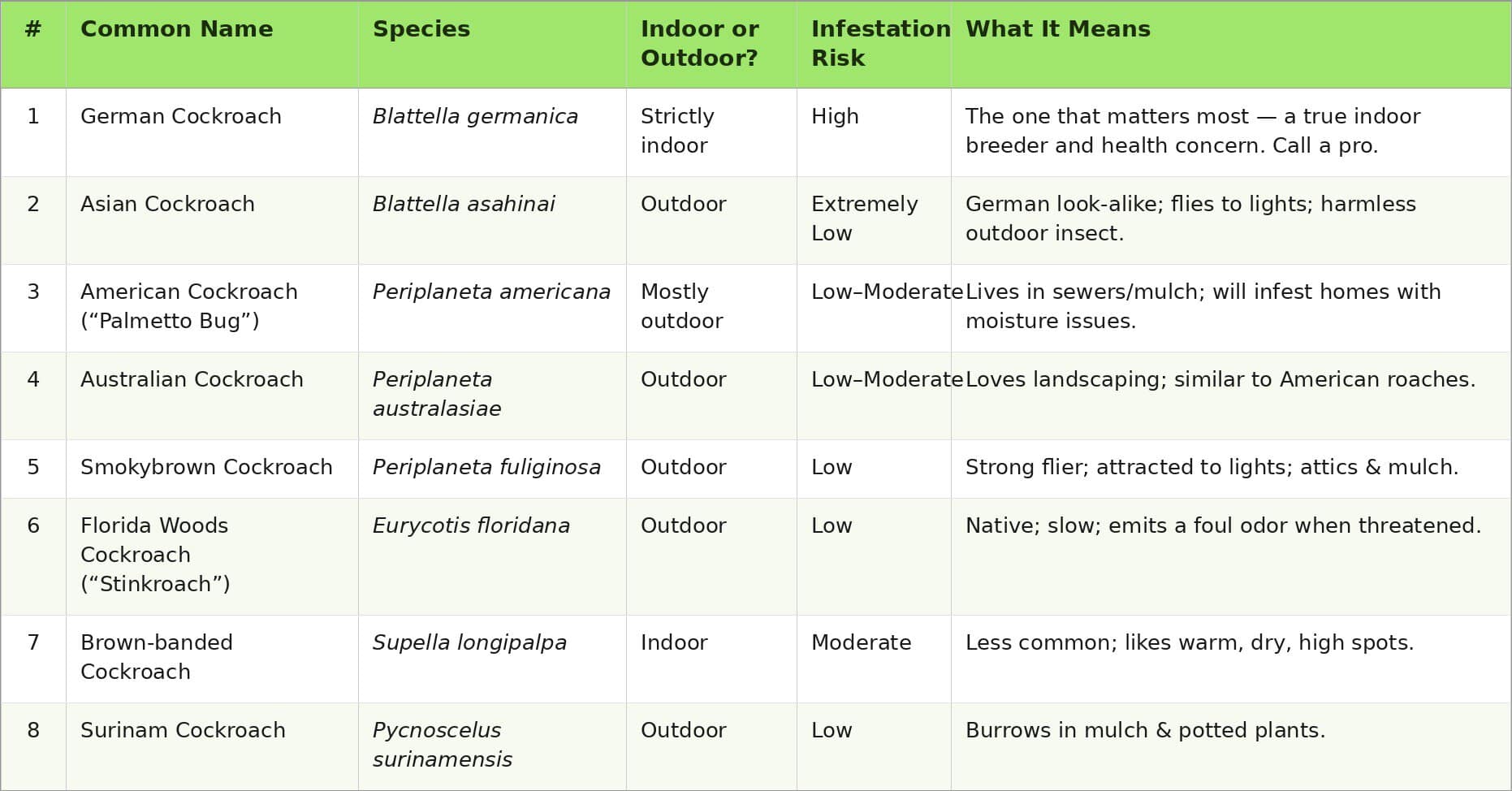
(Click to enlarge)
The short version: Of all of these, only the German cockroach (#1) and the American cockroach are likely to infest the interior of a home — and even then, American cockroaches require unusual levels of moisture, such as a leaky pipe, to infest. The rest are almost exclusively outdoor insects you’re seeing because they wandered in after a heavy rain that flooded them out, or were drawn to light coming from the home. The next section explains the distinction that matters most.

Australian Cockroach hiding between the wall and the doorframe just outside an infant child’s bedroom.
The Distinction That Actually Matters: German vs. Everything Else
Let’s get this out of the way, because it changes everything about how a roach problem should be handled.
German cockroaches are adapted to live and breed indoors. All others are not.
A German cockroach infestation means the roaches are living, feeding, and reproducing inside your walls, cabinets, and appliances. A single female and her offspring can produce hundreds or even thousands of roaches in a year under the right conditions. They thrive in kitchens, they spread bacteria across food-prep surfaces, and their shed skins and droppings are a documented trigger for asthma and allergies — especially in children. This is a genuine health and sanitation issue, and it’s notoriously difficult to clear without professional treatment. If you have German cockroaches, you need professional pest control extermination services.
Another important point about German roaches: they do not come in from outside.
German roaches evolved to live exclusively among people and do not enter from outside. In fact, even within homes they tend to stay put in a very limited area, so long as they have access to food and water. We sometimes hear clients share their suspicion that their German roach issue started because their neighbors have roaches. Unless an item containing roaches or their eggs was carried from the neighbor’s home into the client’s, the neighbor almost certainly has nothing to do with it. Not dissimilar to bed bugs, German roaches are exclusively a “people pest,” and notably cannot be prevented by a pest control company. Even interior sprays are an extremely poor preventive for these bugs, because German roaches are notoriously resistant to the common pesticides labeled for such broad applications.

Palmetto Bugs can infest your home too — though only under unusual conditions.
American Cockroaches, a.k.a. Palmetto Bugs, can infest your home, similar to Germans, but only under certain conditions. These roaches need high humidity to survive. A palmetto bug that finds its way into a home and cannot find its way back out will inevitably be found belly up, because the dry indoor air eventually desiccates its exoskeleton — in other words, it dries up and dies.
The exception is if they are able to find an area of the home with chronic moisture. For this reason, a persistent palmetto bug problem is very often the canary in the coal mine that your home has a more serious issue. Obviously a busted pipe is a dramatic event that any homeowner will notice right away. More typically the moisture issue inside the home is subtle and goes unnoticed. A common scenario we come across is a shower where the tile grout has cracked and the caulking around pipes has deteriorated. As a result, every time someone uses that shower a small amount of water gets into the walls. If multiple people use that shower every day, and this goes on for years, you end up with an interior wall that is chronically wet — a dream scenario for a palmetto bug and the new family they are about to start in your home.
Another common scenario, especially relevant for homeowners in Tradition and St. Lucie West: if the P-trap in a pipe dries up, roaches will enter a home from the sewer system. We see this most often with snowbirds whose homes sit unoccupied for extended periods. The water held in a P-trap is primarily there to prevent sewer gases from entering the home, but it also acts as a barrier to keep roaches out. Over a period of 3 or 4 months, that trap can dry up — and in come the roaches.
The other roaches — Australian, Smokybrown, Florida Woods Roach — are a different story. These are primarily outdoor insects. They live in the soil, mulch beds, downed trees, decaying plant matter, and woodpiles. When you see one inside, it usually gets in through a gap under a door — they can easily enter from underneath a sliding door — or an attic vent. (For clarity, an attic vent is different from your AC vent. AC vents are a closed system and the most inhospitable part of your home, because the air is so cold and dry.) These roaches are not living and breeding inside your home. They’re startling, and worth having a pest control company keep out, but seeing one or two is an exclusion-and-perimeter problem, not a full-blown infestation.
So the first question we ask isn’t “how many did you see?” It’s “what does it look like and where are you seeing it?” A small tan roach with two stripes running around the kitchen at night is a very different conversation than a big reddish roach by the garage door after a rainstorm.
Cockroach Identification Guide: Treasure Coast
Below are the cockroaches we see most often on service calls across St. Lucie and Martin County.
1. German Cockroach (Blattella germanica)
What it looks like: Small — about half an inch long. Light brown to tan. The giveaway is two dark parallel stripes running lengthwise down the shield (pronotum) just behind the head. Adults have wings but essentially never fly.
Where you find it: Strictly indoors, and almost always near food and moisture. Behind and under the refrigerator, dishwasher, and stove — all places where crumbs accumulate; cabinet hinges; around sinks; in the seams of small appliances. If you’re seeing them in daylight, the population is already well established. German roaches are generally nocturnal and reclusive.
Indoor or outdoor? Indoor, full stop. This is what sets them apart from nearly everything else on this list. They don’t live in your landscaping and wander in — they live, breed, and die inside the structure.
Health & concerns: This is the one with real health implications. German cockroaches contaminate food surfaces with bacteria, and their droppings, saliva, and shed skins are a well-documented asthma and allergy trigger, particularly for children. They also reproduce faster than any other house-infesting roach.
Why it matters: A German cockroach sighting is a signal, not an isolated event. Where there’s one, there are almost always many more hidden nearby.
Pest control: Honestly, this is a pest you should call a professional about. The others on this list are debatable, because your tolerance for roach sightings is a personal decision. But with German cockroach infestations, the problem only grows over time, eventually reaching the point of real health implications. Over-the-counter sprays often make German infestations worse — they scatter the population (a process called dispersal) and rarely reach the harborage areas where the roaches actually live and breed. They may kill some roaches, but they absolutely will not solve the problem. Our technicians are specially trained not only to control but to eliminate German roach infestations. We don’t do half the job to pressure you into staying on an ongoing service program — we’ll build a plan with you to SOLVE your German cockroach problem within weeks, not months.
2. Asian Cockroach (Blattella asahinai)

What it looks like: Nearly identical to the German cockroach — small, tan, with the same two dark stripes behind the head. Under a hand lens there are subtle differences, but to the naked eye you basically can’t tell them apart by appearance alone.
Where you find it: Outdoors. Lawns, leaf litter, mulch beds, shaded ground cover. Here’s the key behavioral tell: Asian cockroaches are strong fliers (German cockroaches can’t fly), and they’re drawn to light at dusk. On a warm evening they lift off the lawn by the hundreds or thousands and fly toward lit windows, porch lights, TVs, and open doors.
Indoor or outdoor? Outdoor. They fly in and end up on a lamp or the television screen, but they don’t establish breeding populations inside the way German roaches do.
Health & concerns: Essentially none. They’re a nuisance — an unnerving one when they’re crawling all over the front door as you come home because of the porch light — but they’re not the indoor health threat German roaches are.
Why it matters: This is the single most-confused cockroach in Florida, and the confusion has real consequences. People see a small striped roach indoors, assume “German cockroach infestation,” and either panic or pay for the wrong treatment. The behavior is the tell: if the small striped roaches are flying, showing up at lights at dusk, and concentrated near the yard and doors rather than the kitchen, you’re almost certainly looking at Asian cockroaches, not German.
Pest control angle: Treatment is completely different from German roaches — it’s an exterior, landscape, and lighting problem, not an indoor baiting problem. Here it really matters whether the company you hired is well trained and honest. It’s nearly impossible for the average homeowner to distinguish a German cockroach from an Asian cockroach, but the treatment is dramatically different in scope and price.
3. American Cockroach (Periplaneta americana) — “Palmetto Bug”
What it looks like: Big — the largest common house-invading roach, often 1.5 to 2 inches. Reddish-brown with a pale yellowish band or figure-8 pattern around the edge of the shield behind the head. Fully winged; capable of gliding flight, especially in heat.
Where you find it: Mostly outdoors and in the damp, dark, transitional spaces of a building — sewers, drains, sump areas, mulch, tree holes, and crawl spaces. Indoors they turn up in garages, around floor drains, and in plumbing areas. After heavy rain they push inside looking for drier ground.
Indoor or outdoor? Mostly outdoor, but they’re the classic “came up the drain” invader. They generally aren’t breeding in your living space.
Health & concerns: Because they travel through sewers and drains, they can mechanically carry bacteria. Low risk compared to German roaches, but a good reason to keep them out of food areas.
Why it matters: This is the quintessential Florida “palmetto bug” — the giant roach that triggers the late-night phone call. Alarming, but rarely an infestation in the German-cockroach sense.
Pest control angle: Exclusion and exterior perimeter work do the heavy lifting — sealing drains, door sweeps, screening vents, and treating the mulch and harborage around the foundation.
4. Australian Cockroach (Periplaneta australasiae)
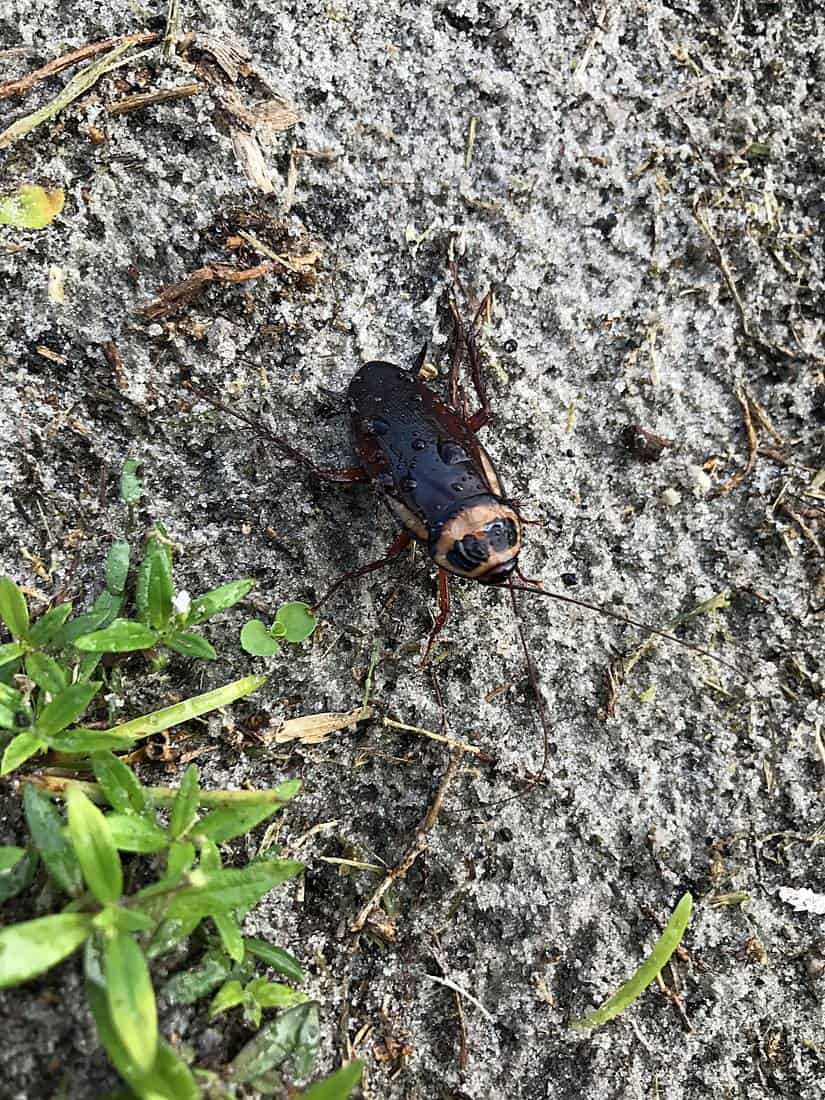
What it looks like: Similar to the American cockroach but a bit smaller and darker, with two distinct pale yellow streaks along the front edges of the wings and a yellow margin around the shield. Once you know the yellow shoulder stripes, it’s easy to separate from the American.
Where you find it: Outdoors, and more plant-focused than the American — gardens, greenhouses, mulch, leaf piles, and around the foundation in dense landscaping. It actually feeds on plants and can nibble seedlings and tender foliage.
Indoor or outdoor? Outdoor. Comes inside occasionally, usually near doors and garages adjacent to heavy landscaping.
Health & concerns: Low. Nuisance invader.
Why it matters: Common in our lush, irrigated Treasure Coast landscaping, but not an indoor breeder.
Pest control angle: Same general playbook as the other large outdoor roaches: exterior treatment, harborage reduction in the mulch and foliage, and exclusion at entry points.
5. Smokybrown Cockroach (Periplaneta fuliginosa)
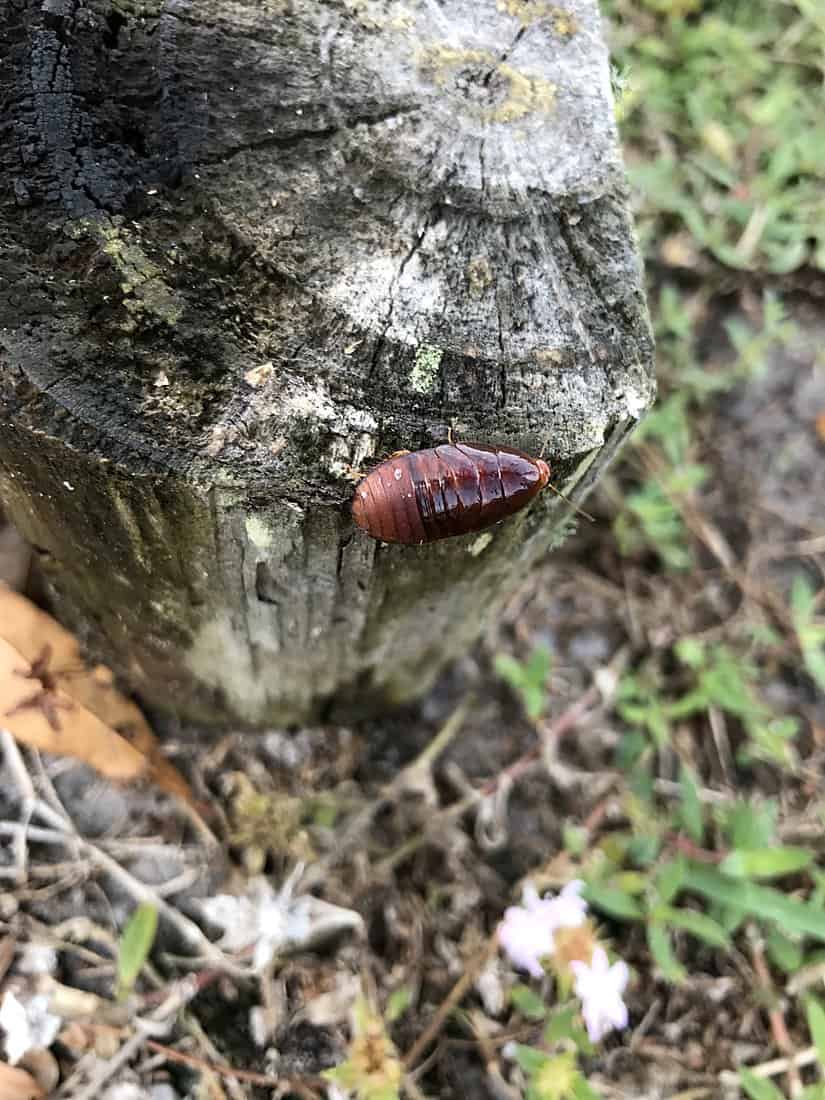
What it looks like: Large, uniform glossy dark brown to mahogany — no pale markings like the American or Australian. Sleek and shiny. Fully winged and a strong flier.
Where you find it: Outdoors in attics, soffits, tree holes, mulch, woodpiles, and gutters full of leaf debris. They lose moisture easily, so they stick to humid, sheltered spots. They’re powerfully drawn to lights and will fly to porch and pool lighting at night.
Indoor or outdoor? Outdoor, but they readily get into attics and upper levels — sometimes coming down into the living space from above rather than up from the ground.
Health & concerns: Low, similar to the other large outdoor species.
Why it matters: A very common large roach here, and the attic/soffit angle means people sometimes find them dropping in from above and assume the worst.
Pest control angle: Gutter and attic harborage matter a lot with this one — clearing leaf debris, treating soffits and the roofline, and addressing exterior lighting.
6. Florida Woods Cockroach (Eurycotis floridana) — “Stinkroach”
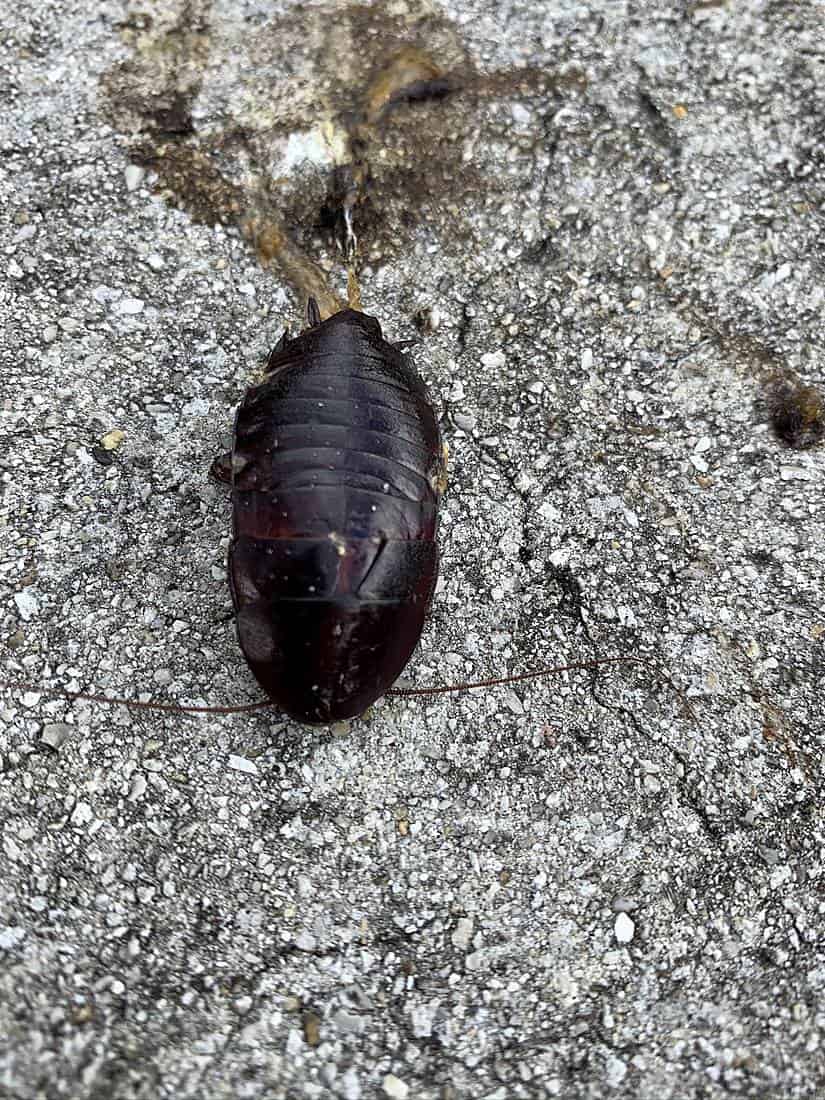
What it looks like: Large, broad, very dark reddish-brown to almost black, with a notably thick, armored, sluggish appearance. Adults have only stubby, non-functional wings — this one doesn’t fly. It’s a slow, lumbering roach.
Where you find it: Outdoors, native to Florida — leaf litter, mulch, under bark, in woodpiles and palm boots. It’s a true native that was here long before the development was.
Indoor or outdoor? Outdoor. An occasional accidental invader at ground level.
Health & concerns: Low — but it has a memorable defense: when threatened, it releases a foul-smelling chemical, which is why it’s nicknamed the “stinkroach” or “skunk roach.” Harmless, just unpleasant.
Why it matters: Another roach lumped under “palmetto bug.” Slow, native, outdoor, and not an infestation risk. Most common in woodpiles and underneath outdoor debris, and more common in rural areas than in urban environments.
Pest control: Exterior and harborage focused — mulch, ground debris, and entry-point exclusion.
7. Brown-banded Cockroach (Supella longipalpa)
What it looks like: Small, similar in size to a German cockroach, light brown — but instead of two lengthwise stripes on the shield, it has two lighter bands running across the wings and abdomen. Males are slender and can fly short distances; females are broader.
Where you find it: Indoors, but unlike German roaches it doesn’t cling to the kitchen and bathroom. Brown-banded roaches prefer warm, dry, elevated spots — behind picture frames, inside electronics, in closets, near ceilings, and in furniture. You’ll find them higher up and farther from water than German roaches.
Indoor or outdoor? Indoor. Less common here than German roaches, but it can establish indoor populations.
Health & concerns: Moderate — as an indoor species it shares some of the contamination and allergen concerns of German roaches, though infestations are usually smaller and less common.
Why it matters: Because it hides in different places than German roaches, it can be missed or mistreated if someone assumes all indoor roaches behave like German roaches.
Pest control: Treatment is indoor and harborage-driven like German roaches, but the inspection has to cover the warm, high, dry areas they favor — not just under the sink.
8. Surinam Cockroach (Pycnoscelus surinamensis)
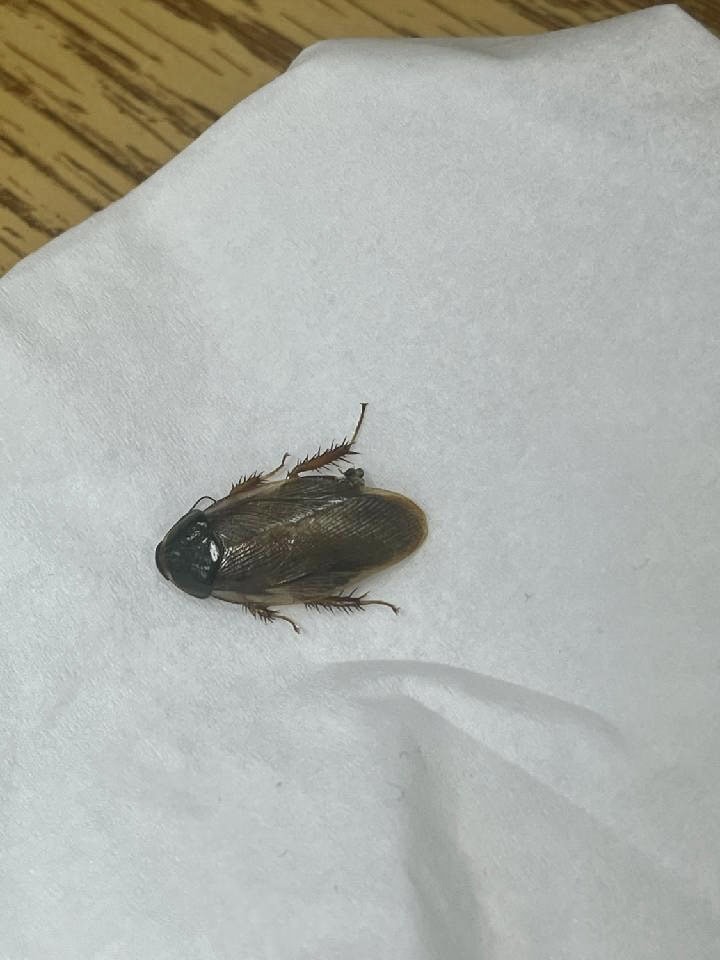
What it looks like: Medium-sized, shiny dark brown to black body with a tan/brown shield behind the head and dark wings. Stout, built for digging.
Where you find it: Outdoors, in mulch, potted-plant soil, flower beds, and landscaping. It’s a burrowing roach. Interesting biology note: in our area Surinam cockroaches are essentially all female and reproduce by cloning themselves (parthenogenesis) — no males needed.
Indoor or outdoor? Outdoor. It mostly comes indoors as a stowaway in potted plants.
Health & concerns: Low to people. It can damage plants by chewing roots and foliage, so it’s more of a landscaping pest.
Why it matters: Common in mulch-heavy Florida landscaping and frequently hitchhikes indoors in container plants. Almost entirely confined to the soil — most likely to be seen while digging in the yard or coming up out of the ground after a heavy rain. Almost never found indoors.
Pest control: So rare inside that it would be hard to classify this roach as a “pest.” Control is relatively easy nonetheless — standard perimeter pest control should do the trick.
Before we go any further — there are basically only TWO species of roach that are common pest control issues in our area: the American Cockroach and the German Cockroach. You may have already done some searching online and suspect what you are seeing is a Smokybrown Roach or a Florida Woods Roach. If the roaches you are concerned about are on the floor in your home, it’s far more likely what you’ve seen is an immature American Roach. It’s easy to forget “Palmetto Bugs” are not born 2 inches long. As these roaches grow from nymph to adult they change shape and color, making misidentification common.
If the small roach you saw was on your counter, or inside drawers and cabinets, you may have a German Roach problem.
Here’s the thing most people don’t realize about cockroaches in Florida: the big ones (though scary) aren’t the worst ones. It’s the small ones that should have alarm bells going off.
This may feel backwards since the large roaches can be so scary, but let us explain. The large roaches you see scuttling across the garage floor or running up the wall of your patio at night — the ones everyone around here calls “palmetto bugs” — are mostly outdoor insects that wandered in by accident. These roaches cannot survive indoors for very long, even absent any sprays. Palmetto bugs (American Cockroaches) are evolved to thrive in hot, humid climates; they dry up and die in the climate-controlled conditions of our homes — with one exception that we will detail in a moment. They are an unsettling nuisance, but under normal conditions they are not an infestation. The roach that actually signals a problem is small, light brown, and lives strictly indoors: the German cockroach. This is the species of cockroach most people think of when they picture an infested apartment in New York City. German roaches reproduce quickly, can trigger allergies and asthma, and generally are going to require a call to a professional exterminator.
And then there’s the impostor — the Asian cockroach — which looks almost exactly like a German cockroach but is actually a harmless outdoor insect that flies to your porch lights on warm evenings. People panic thinking they have a German roach infestation when they’re really just looking at a lawn bug that drifted toward the TV. Interestingly, German cockroaches evolved from Asian cockroaches only a couple thousand years ago, essentially the domesticated product of the latter.
We’ve put together this guide to the cockroaches our technicians actually encounter in St. Lucie and Martin County homes — what they look like, where they live, whether they mean trouble, and what (if anything) you should do about it. No scare tactics.
“Help, I Have German Cockroaches!” — Wait, Do You?
Before you panic over small striped roaches, run through this. It’s the single most useful thing on this page, because it’s the mistake we see most.
You’re probably looking at ASIAN cockroaches (outdoor, harmless) if:
- They’re flying, especially toward lights at dusk
- You see them outside on the lawn, in mulch, or at the porch/pool light
- They show up on windows, screens, the TV, or lamps — drawn to light
- The sightings spike on warm, humid evenings and around your landscaping
You may genuinely have GERMAN cockroaches (indoor, call a pro) if:
- They’re concentrated in the kitchen — particularly NOT on the ground, but in drawers, cabinets, and on countertops
- They are not flying to lights
- You’re seeing droppings (which look like ground pepper or coffee grounds) or small brown egg sacs
If it’s still not clear, take a photo and send it to us. You can text our office at 772-528-5839. We’d rather tell you it’s a harmless outdoor bug than sell you a treatment you don’t need.
When to Call for Pest Control for Cockroaches
You should call a professional if:
- You’ve identified (or suspect) German cockroaches indoors — this is the one that rarely resolves on its own
- You’re seeing roaches in daylight (indicates a large hidden population)
- You find droppings, shed skins, or egg cases in cabinets, drawers, or appliances
- DIY sprays and store-bought baits haven’t worked — or seem to have made it worse
- You run a restaurant, food-service, or commercial property where roaches are a health-code and reputation issue
- Large outdoor roaches (“palmetto bugs”) are getting inside regularly, which points to entry points and harborage that need addressing
You probably don’t need much beyond exterior prevention if:
- You saw one large “palmetto bug” after a rainstorm
- The small striped roaches are flying to your lights at night (Asian cockroaches — a landscape/lighting issue, not an indoor infestation)
- You found a roach in the garage or by a drain
We’ll be honest with you either way.
Cockroach Control Services — What We Do
Interior German Cockroach Treatment — While we, like all pest control companies, are in the business of providing ongoing services, they are not necessary for German roach infestations. Because German roaches don’t come in from the outside, one-time treatments — along with a discussion about how the roaches got into the property in the first place — are all that’s needed. Targeted gel baiting, growth regulators, and crack-and-crevice work in kitchens, bathrooms, and appliance voids, with follow-up visits to break the breeding cycle. Sanitation guidance included, because cleanup is half the battle with German roaches, especially during treatment.
Exterior Perimeter & Harborage Treatment — Treatment around the foundation, drains, mulch beds, soffits, and entry points to keep the large outdoor “palmetto bug” species from getting in.
Exclusion Recommendations — We identify and help you close the gaps roaches use: door sweeps, drain covers, sealed utility penetrations, screened vents. The most effective long-term roach control is keeping them out in the first place.
Eco-Friendly & Traditional Options — Like the rest of our services, we offer less-toxic, pet- and child-friendly approaches using professional-grade mineral-based products, as well as conventional options.
Ongoing Maintenance Plans — Regular service keeps populations down and catches problems early, which matters most for the large outdoor roaches and for commercial accounts.
FAQs — Cockroach Control on the Treasure Coast
Q: What’s the difference between a German cockroach and a “palmetto bug”?
Size and lifestyle. German cockroaches are small (about half an inch), light tan with two dark stripes, and live and breed indoors — that’s the one that signals a real problem. “Palmetto bug” is the local nickname for the big (1.5–2 inch) reddish or dark-brown roaches like the American and Florida woods cockroaches, which mostly live outdoors and wander in. The big ones are alarming; the small ones are the actual infestation risk.
Q: I have small striped roaches flying to my porch light. Are they German cockroaches?
Almost certainly not — German cockroaches can’t fly. If they’re flying to lights at night, especially near the lawn and landscaping, you’re looking at Asian cockroaches, a harmless outdoor look-alike. The treatment is completely different, so the ID matters.
Q: Are cockroaches dangerous to my health?
German cockroaches are the real concern — their droppings and shed skins trigger asthma and allergies (especially in children), and they can spread bacteria on food surfaces. The large outdoor roaches are mostly a nuisance, though any roach that’s been in a drain or sewer is worth keeping away from food.
Q: Why do I have cockroaches if my house is clean?
Most of the roaches we see in Florida are outdoor insects that came in through gaps, drains, or attic spaces, or flew to a light — that has nothing to do with how clean your home is. German cockroaches are the exception: they’re tied to food and moisture indoors, but they’re also frequently brought in — in grocery boxes, used appliances, or secondhand furniture — not a reflection on housekeeping.
Q: Will store-bought sprays get rid of German cockroaches?
Almost never. You would literally be better off killing each one individually with a shoe and a handheld vacuum — at least that won’t make the problem worse. Sprays tend to scatter the population (dispersal) and rarely reach the hidden harborage where roaches breed. German cockroaches are best handled with targeted baiting, growth regulators, sanitation, and follow-up — which is why this is the roach worth calling a professional about.
Q: How do I keep palmetto bugs out of my house?
Exclusion and exterior maintenance. Seal gaps under doors, cover and maintain drains, screen vents, clear leaf debris from gutters and around the foundation, and keep mulch and woodpiles back from the house. A regular exterior treatment keeps the pressure down.
Q: Are roaches covered under a regular pest control plan?
Absolutely. All roaches that come in from the outside — and are therefore preventable with regular pest control maintenance — are covered under our most basic plan. As for German cockroaches, which have to be brought in, we’ll typically provide a complimentary treatment for our regular clients.
Q: Can you tell me what kind of roach I have from a photo?
Absolutely. Shoot us a text at 772-528-5839.
Service Areas — Cockroach Control
Green Pest Services provides cockroach identification and control throughout St. Lucie and Martin County:
- Port St. Lucie (34987) — Tradition, Southern Grove, St. Lucie West
- Palm City (34990) — Martin Downs
- Stuart — Downtown Stuart, Jensen Beach, Hobe Sound
- St. Lucie & Martin County — All zip codes
If you’re on the Treasure Coast and dealing with cockroaches — or you’re not sure what you’re seeing — give us a call at 772-528-5839. We’ll identify it, tell you honestly whether it’s a problem, and recommend treatment only if it actually makes sense.
Why Green Pest Services?
- Local experts — We live here. We know the difference between an Asian cockroach on your porch light and a German cockroach in your kitchen because we see both every week.
- Honest recommendations — If you don’t need treatment, we’ll tell you. If you do, we’ll explain why.
- Accurate identification — We won’t turn a harmless lawn roach into an “infestation” to sell a service.
- Eco-friendly options — Professional-grade botanicals and refined minerals, pet- and child-friendly, alongside traditional options. Your choice.
- Licensed & insured — Professional pest control operators, not a guy with a spray can.
We treat every Port St. Lucie home like our own — honest service, pet-safe methods, and next-day appointments when you need us. Our clients consistently leave great reviews on our service.
-Shane Green. CEO, Green Pest Services FL